

|
________ Last updated 06/09/10
|
Samuel Magnus Hill - Poems Translated into EnglishTable of ContentIntroduction by Lars Nordström “Ottarsmaja” ”The Tenant Farmer’s Son” Part II: Impressions of America “One Ought to Live a Higher Life” “Ode to Routines” “The Count” “A Contemporary Mary Magdalene” “America” “Übermensch” “Saint Hoover” “The Riddle of the Sphinx” “Sweatshops and Cannon Fodder” “I Cannot” “The Sacrificial Act” “On My Sixty-Third Birthday” “The Oregon Song” “Greetings to Sweden” “In the Pretty Karlsborg Valley” “Among Stumps and Logs” “The Emigrant’s Homesickness”
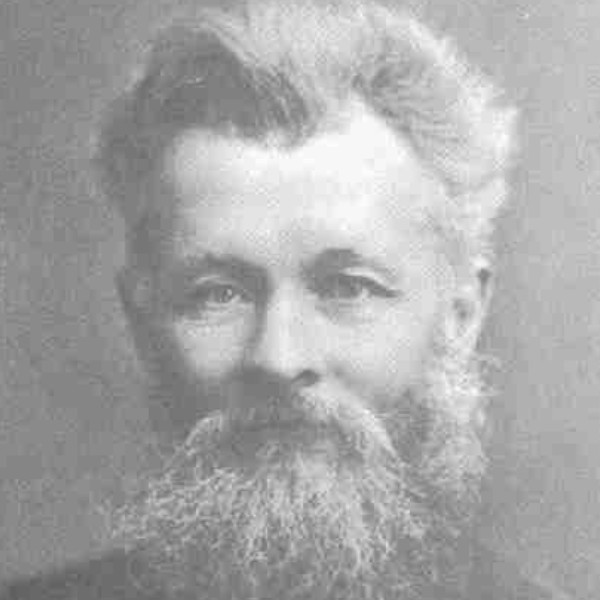
Samuel Magnus Hill (1851–1921) holds the distinction of being the only person (so far) to have ever published a volume of poetry in Swedish in the state of Oregon. Hill’s chapbook, entitled Uggletoner i vargatider [Laments in the Time of the Wolf] was published in 1916 in Portland, Oregon, at the poet’s own expense. The release ad appeared in Oregon Posten on August 30, 1916.
Even though Hill’s chapbook contained poems on a number of different themes, it mainly argued ironically and satirically against the senseless death and destruction generated by World War I. In 1915 Hill was on a sabbatical/early retirement in Oregon, and it gave him time to write. Judging from the surviving number of poems dated from this period, his literary output increased significantly. He was also busy trying to find a publisher for his recently completed translation into English hexameter of Virgil’s Æneid, a publisher which he never found. Ever since his college days at Augustana College in Rock Island, Illinois, where he graduated in 1879, Hill had enjoyed expressing himself in writing. His articles, commentaries, poems, and songs were published in various Swedish-language newspapers and magazines across the United States. He wrote almost exclusively in Swedish, and, as is common with so many academic writers, irony was often employed in his poetry. In 1890, a selection of religious poems were published in an anthology of four Swedish poets entitled Fyrväplingen: valda stycken [The Four-leaf Clover: Selected Pieces]. It was published by Omaha-posten [The Omaha Post], a Swedish-language newspaper in Nebraska. Samuel Magnus Hill’s writings were very much an expression of his beliefs and convictions, and to a great extent his personality had been shaped by his youth in Sweden from which he emigrated with his family at age 17. In his early years he had experienced extreme poverty, discrimination due to his family belonging to the Pietist movement, and living at the bottom of a class society with a set of rigid rules intended to preserve the status quo. As the first part of his unpublished biography makes clear, he saw Sweden as a society that would never offer him any possibility of advancement. These circumstances were powerful factors that shaped his view of the world, and they often surface in his poetry. By working hard and becoming a college professor first at Gustavus Adolphus College and then at Luther College, Hill became a life-long advocate of the importance of education, of personal effort, and striving. For many years, Samuel Magnus Hill worked as one of the literary editors of the Swedish language magazine Ungdomsvännen [Youth’s Friend], which was published on and off in various places (Chicago, Minneapolis, and Rock Island) between 1879 to 1918. During his 1901 trip back to Sweden, Hill attempted to contact a number of prominent Swedish authors, politicians, and religious leaders, and after his return to Nebraska, he introduced many of them to the Swedish-American readers of the magazine. He wrote to the well-known Swedish Socialist Hjalmar Branting, and he entered into a correspondence with author and first woman Nobel Prize Winner for Literature, Selma Lagerlöf. Hill tried first to interest Lagerlöf in co-authoring a new book on teaching grammar, then he tried to persuade her to come to America to write a novel about the Swedish Americans. Hill offered to help organize a tour across the United States, and to connect her with prominent individuals and institutions, but as we know, nothing ever came of Hill’s efforts: Selma Lagerlöf never made the trip across the Atlantic. Hill was clearly also attracted to some of the Socialist ideas of his time—and perhaps influenced by the muckraking journalism of the early 20th century—and shared the Socialist resentment of inherited wealth and power. He also resented imperialism, especially the activities of the British Empire, and saw war (again like many of the Socialists did) as a struggle between different powerful economic interests, which caused nothing but suffering for ordinary poor people. From Hill’s surviving letters, we learn that he worked tirelessly to influence American politicians to remain neutral in World War I, and the US decision to enter the war clearly disillusioned him. The poetry Hill wrote in Oregon following his Uggletoner i vargatider, was never gathered into second volume. Almost all of the poems from his last years falls into one of two categories: quickly assembled occasional verse on everyday community events such as deaths, birthdays, and wedding anniversaries, and more personal poems marked by homesickness for Sweden, resignation, the madness of poverty, war, inequality, injustice, and a deep yearning for God. Samuel Magnus Hill kept writing, and the poems piled up in his drawer. They are now preserved in the Samuel Magnus Hill Collection at the Swenson Center at Augustana College, Rock Island, Illinois.
All translations © Lars
Nordström
OttarsmajaOttarsmaja, I remember her well, That’s where I learned my ABCs.
Ottarsmaja, I remember her well,
Once a year they got together And so the message came to us one
day Old grandmother, I remember her
well, And Maja i Vännerbjörk
I later met
January 24, 1915. My grandmother died January 24, 1857, and was buried a week later on a Sunday. It was the first funeral I ever experienced.
[Augustana College, Swenson Center Archive, Hill Collection, Box 4, Folder 2.]
* * *
The Tenant Farmer’s SonI was born a tenant farmer’s boy
”Have we done enough?” Suddenly a possibility opened up, Much I have found and much I have
wasted Tenant farmer slaves, listen: May seventeenth, 1915.
[Augustana College, Swenson Center Archive, Hill Collection, Box 4, Folder 3.]
Note: The date of composition, May 17, is the Norwegian day of independence (from the Danish constitution).
Part II: Impressions of America
One Ought to Live a Higher Life
One ought to live a higher life,
Nah, that’s just passing the time
No, give me the life of a pig any day,
From now on I will be a wise man
Why carry the yoke of burden
I don’t want to reach the higher spheres,
Grand Junction, Iowa, October 12, 1898.
[Augustana College, Swenson Center Archive, Hill Collection, Box 4, Folder 2.]
* * *
Ode to Routines
Routine, oh routine,
When you see something
The way it was for father and
grandfather
Well, Mr. Routine, you better
[Published in Ungdomsvännen, Årgång XXIII, No. 9, September 1918, s. 215.] * * *
The Count
I remember the man with the high forehead,
He speaks slowly, nothing is no longer urgent,
He speaks of his Agnes with great delight,
The evening of his life sinks into shadows,
But what he himself and she had been,
I don’t ask, because he who has experienced grief,
He had served, he said, at the royal court. What could have forced him away? Was he misled by obsequious
praise, Rivers of champagne flow there,
Yes, that’s when life might fall apart.
The newspapers carried a story from Stockholm,
It was a courtier with the rank of a count,
And eventually, from a Swedish paper in Ohio,
And these two I now add together:
I am not dressing up the story of his life,
This country has been a place of refuge
But from the royal court and from Sweden’s upper classes
[Augustana College, Swenson Center Archive, Hill Collection, Box 4, Folder 2.]
* * *
A Contemporary Mary Magdalene
She stood as Mary Magdalene once
did,
And the judge sat there so ominous
and glum. He sat as a judge and had to
sentence a woman
That was what she ought to do,
since propriety
“A fifty dollar fine and off to
jail!”
What noise and din! Fainting
women and
March 6, 1914. Submitted to Nya Idun [a magazine].
[Augustana College, Swenson Center Archive, Hill Collection, Box 4, Folder 3.]
* * * America
They boast a great deal about equality,
Without answering I’d rather swallow my annoyance
Here, gold measures human worth,
We are not tormented by aristocrats,
Nonsense! Here we are ruled by rascals,
Politics is merely a system of plundering,
No, my friend, you won’t find paradise here,
You change your name and receive the prize,
Yes, the race of Adam lives here too
The beautiful land that your eyes saw,
[From the anthology Amerika-Svensk Lyrik genom 100 år, 1848-1948 [100 Years of Swedish-American Poetry, 1848-1948], edited by Martin S. Allwood, 1949.]
* * *
Übermensch
I stand, by far the foremost on earth,
I walk scornfully and haughtily through the misery,
Resistance is crushed wherever I advance,
No one can contain power,
I despise the small ones who crawl. They
You may find all kinds of faults with the law,
The riffraff should know that power equals right,
I alone decide both means and ways,
People’s children are my slaves,
Frugally they earn their own food;
Day after day I whip their sons to keep moving,
The daughters of the people offer me the treasure
Those who crawl shall be forced. Am I not God? Who could become my superior?
Everything shall obey the rules of my reign,
Tranquilly I gaze down from the heights;
I am the ruler, peace surrounds me,
[From the anthology Amerika-Svensk Lyrik genom 100 år, 1848-1948 [100 Years of Swedish-American Poetry, 1848-1948], edited by Martin S. Allwood, 1949.]
* * *
Saint Hoover
Saint Hoover, listen to us!
Listen to us, Saint Hoover!
You fixed the price on wheat,
For a long time to come
Hail to thee, Saint Hoover!
The children of the future will
worship you.
Saint Hoover, lead us!
S.M.H. One of Hoover’s admirers.
[Augustana College, Swenson Center Archive, Hill Collection, Box 4, Folder 2.]
Note: Herbert Hoover, 1874 –1964, the thirty-first US President (1929 – 1933). Hill passed away in 1921, eight years before Hoover became President, so this poem praises Hoover’s work as head of the US Food Administration during the World War I. During the war, Hoover succeeded in reducing the food consumption needed overseas while avoiding rationing at home, yet also managing to keep the Allies fed. After the armistice Hoover directed the American Relief Administration and organized shipments of food for starving millions in central Europe.
* * *
The Riddle of the Sphinx
The overpopulation problem is the riddle
The existing solution is hunger and pestilence,
No one, however, likes that very much, because
Lions and tigers have a nature like this, they take
But the law of the predator seems too base. Our “If thine eyes offend thee, or thy hand or thy foot,
cut it off.” That is certainly the answer,
You’ll find the key in God’s identical words, and
Tell the Sphinx that, watch his face, and
The overpopulation problem is solved, and its
“Alas, mankind will not be saved,
[From Uggletoner i vargatider, 1916.]
Note: It is obvious from Hill’s writings that the over-population problem was something that he frequently thought about. The biblical reference is somewhat freely quoted from Matthew 5:28 - 30, which states the traditional Christian solution of sexual urges by advocating abstinence. In this matter Hill did not side with the Socialists, who instead argued for readily available means of birth control.
* * *
Sweatshops and Cannon Fodder
Too many cooks spoil the broth,
Often I have heard it said: The
more mouths,
But sweatshops need bodies,
Because next year, when she had
become a mother,
Daughters of Sweden, who will
bring you back
It is not enough for her to have
just one,
For the love of mankind we try to
fill their stomachs,
You should learn this one lesson:
They too, ought to be raised as
men and women Let those who live in our nation’s
palaces
You love God; do you love your
neighbor?
Rainer, Ore. [sic] June 17, 1916. [Rainer is located in Washington state, not Oregon.]
[Augustana College, Swenson Center Archive, Hill Collection, Box 4, Folder 2.]
Notes: Krupp was the name of a German arms manufacturer. It is clear that Hill saw that having many children simply meant increasing hunger and poverty for the poor. He also realized that it was their children who ended up in factories and armies, and suspected that this was somehow orchestrated by the wealthy ruling class. As in the previous poem, Hill’s view was that the solution to the problem was abstinence—not birth control—on the part of women. A paternalistic view permeates this sermonizing poem in that it addresses women and admonishes them to refrain from sexual activity, while ignoring the men’s responsibility. Compared to “A Contemporary Mary Magdalene” this poem presents a much narrower view. Elsewhere Hill also advocated that in order to keep the family small, young men should marry older women who were past their prime child-bearing age.
Part III: Antiwar Poems
I cannotI cannot sing and praise the god
of war,
I cannot remain silent when women
are violated
I cannot praise those statesmen
who use violence and force
I cannot believe that all power
belongs to Satan
The Prince of Peace rules, and he
alone will
The day of peace, August 13, this cursed year 1914.
[From Uggletoner i vargatider, 1916.]
* * *
The Sacrificial Act
One evening I saw the
sacrificial act
Keepsake gifts, a last will and
testament
I envisioned the bloody rags of
the khaki boys
The war has created thirty
thousand
Dear Lord, what crazy madmen!
As I watched
the farewell party for the thirteen boys who were drafted
[Augustana College, Swenson Center Archive, Hill Collection, Box 4, Folder 2.]
Note: When Hill uses the expression the “hyphenated immigrants,” he is referring to the Swedish-Americans. Hill shared the view of many on the political left that the war was promoted by a circle of industrialists and manufacturers who stood to gain financially from the sale of arms and munitions. Hill also always argued strongly against the principle “might makes right,” what he often referred to as “the law of the predator.” Perhaps Hill’s later disillusionment in life stemmed from his view in this poem that God had the power to stop this, but—as became obvious as the war raged on—did not, perhaps indicating that it was indeed the financial interests that had the supreme power.
Part IV: The Final Years
On My Sixty-Third Birthday
How empty and cold life is here,
Toil and trouble is all there is, What is our life? A mere shadow.
And fighting and quarreling How empty and cold life is here, absolutely nothing amuses me!
I thought things would get better,
I was supposed to be free from sorrow
But sorrow consumes
My future is I thought things would get better, when the days of old age arrived.
O Lord, I take
refuge in you; Lovingly you direct
everything,
[Augustana College, Swenson Center Archive, Hill Collection, Box 4, Folder 2.]
Note: There are two slightly different versions of this poem in the Swenson Center Archive, Augustana College Hill collection, one in Box 4, folder 2, and one in Box 4, Folder 3. The latter contains a note written in Hill’s handwriting: “Mel[odi]. Vid Jesu hjärta, där är rum.” Since Hill was born in 1851, this poem would presumably have been written in 1914.
* * *
The Oregon Song
Oregon, Oregon, glorious are thy mountains,
Glacier-clad, snow-bedecked source of all thy fountains,
Whispering in the tree-tops, and
River-swept, ocean-bound, roar of the waves majestic,
Sportingly in the brooklet,
Step aside, far and wide! Here come the Oregonians! Free [we] are near and far until our mountains fall. Sylf and sprite now invite: “Come and be Oregoni[a]ns! Room we have, boom we have, here is a place for all.
Here you can build your mansion, and The fisherman and the hunter give answer to the call.
[Augustana College, Swenson Center Archive, Hill Collection, Box 4, Folder 1.]
Note: This song is one of the few originally written in English. There is no remaining notation attached to this song.
* * *
Greeting to Sweden
From the idyllic Karlsborg Valley
Speak of childhood memories, speak
Swedes in the east, north, and south,
We were Swedish-born, and our love still glows
Could we forget our childhood days?
Aren’t Swedes still forced to leave because of preposterous laws,
Even so, Sweden is that land on earth
Tell those back home that Swedish hearts
Tell them that longing and the pain of being a stranger
Foolish brats who don’t know very much,
Say hello to our people in the great North,
Yet only laws can build a land,
[Augustana College, Swenson Center Archive, Hill Collection, Box 4, Folder 4.)]
Note: This undated poem must have been written fairly late since it is sent out from Oregon. The reference to “the eagle of war” being “well fed” suggests that it was composed toward the end of (or after) World War I. The poem hints at some grudge Hill apparently held against certain laws in Sweden causing emigration—laws which he apparently felt were not “true and just.”
* * *
In the Pretty Karlsborg Valley
In the pretty Karlsborg valley
Unaffected by time’s voices,
In the forest’s dusky bosom, We remember the flower king
Now when the flowering has come
Let us never, never forget,
Mel. ”Fjäriln vingad är [sic] på Haga”
[Augustana College, Swenson Center Archive, Hill Collection, Box 4, Folder 4.]
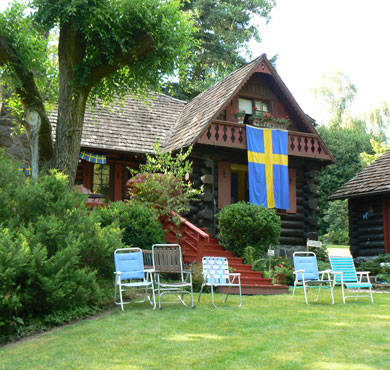
Note: Karlsborg was the only organized Swedish ”colony” in the state of Oregon. It was founded early in the 20th century by Rev. Carl J. Renhard and actively promoted the settlement of Swedes up through the 1920s. The name of the existing post office was Colton, the name the community bears today. Hardly a valley, Karlsborg was located fairly high up in the foothills of the Cascade Mountains, about 30 miles south of Portland. Samuel Magnus Hill is buried in the Lutheran Pioneer Cemetery in Colton. This song uses the well-known melody of Carl Michael Bellman’s (1740 – 1795) famous song “Fjäriln vingad syns på Haga.” The scheme of the eight syllable line followed by a seven syllable line has been kept in the translation, even though the rhymes have disappeared in order to preserve the meaning of Hill’s text. Hill’s use of the word “furn” in the Swedish text is one of the few instances of “Swenglish” in his poetry. The word does not refer to a pine (fura in Swedish), but to the most common evergreen in Western Oregon, the Douglas fir.
* * *
Among Stumps and Logs
I spend my days among stumps and
logs,
The giants have competed with each
other I have heard the owls in the
boundless forest, When the fools make noise I think
like this: Should one sympathize with a herd
of fools
[Augustana College, Swenson Center Archive, Hill Collection, Box 4, Folder 3.)]
Note: In the last stanza of this poem, Hill plays with the old Swedish expression ”sätta bocken till trädgårdsmästare,” [make the billy goat the gardener], that is, give someone a task for which he is very poorly suited, by suggesting that the billy goat also has such a bad temper that he is dangerous as well. It is reminiscent of the English expression ”make the fox guard the hen-house.”
* * *
The Emigrant’s Homesickness
Oh, dear native land,
Oh, little cabin, which meant so
much to me,
There is no other place on earth
Melodi: Mellem bakker och bjerg invid havet. [Augustana College, Swenson Center Archive, Hill Collection, Box 4, Folder 4.] |